



The stories · One stone, two names
Robert and Jehenne,
450 years of prayers.
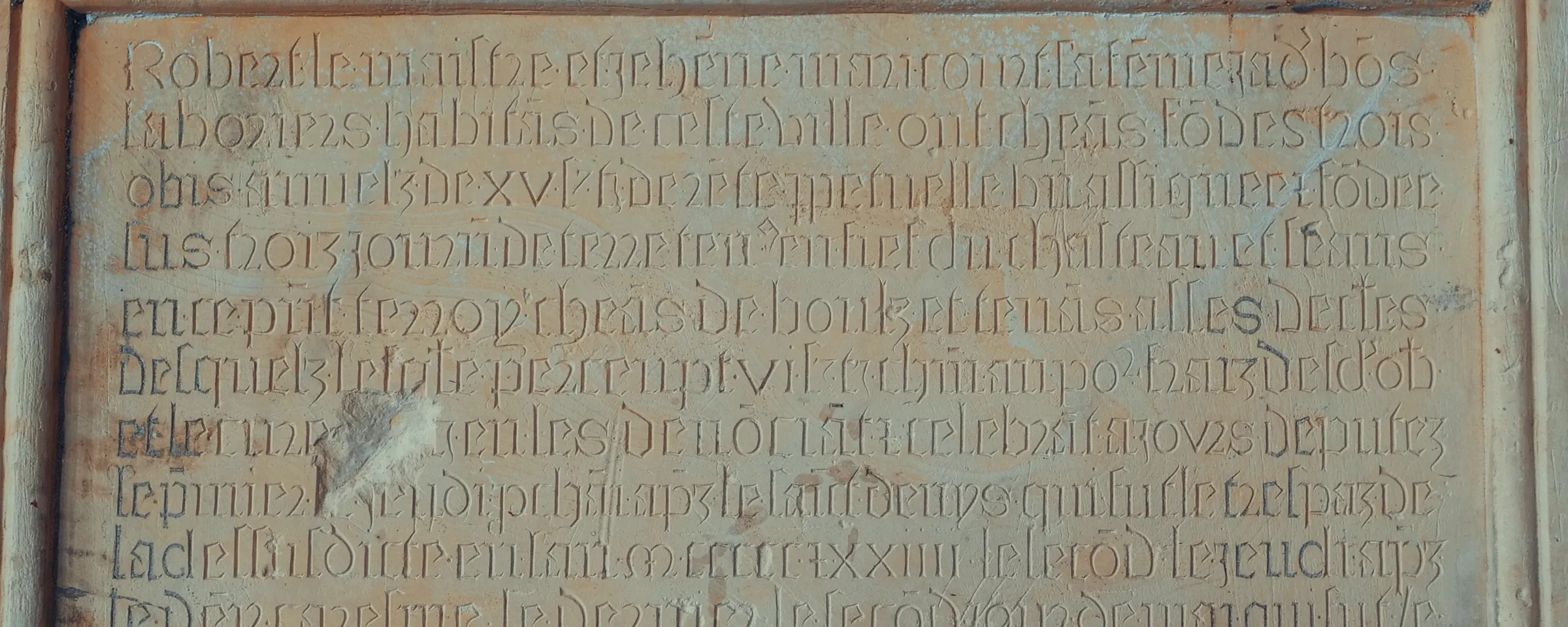
A plaque engraved in the 16th century, hanging on the church wall. Here are its transcription, its translation and a few explanations.
Listen to the poem
The six lines of the plaque, set to music: in Latin, the original language, and in your language.
The poem in Latin (original version)
Show the Latin text
Elogio tenui claros laudabo parentes,
Aemula quos vere gloria laudis alit.
Laus: proba vita Deo,
pietas sua cognita mundo.
Quid referam?
Gestis res patet ipsa suis.
His igitur, lector, meritos optabis honores,
Ut scandant celsi fulgida ad astra poli.
The poem in English
Song lyrics (free adaptation of the poem)
With these humble verses, I sing
In memory of these noble parents.
May their glory live on,
May their names endure through time.
Their honour was an upright life
Beneath the eyes of God,
And their devotion, known to all,
Bore witness to their faith.
What more could I tell you?
Their deeds speak for themselves.
You who read these words,
Wish them the honour they deserve,
That they may rise to heaven,
Towards the light of the stars.
Songs created with the help of artificial intelligence from the engraved poem. The players only start when you press play. The lyrics in your language are a free adaptation for the song.
The stone at a glance
A couple of ploughmen, three masses a year secured by an income from the land, and a Latin poem: the essentials in a few lines.
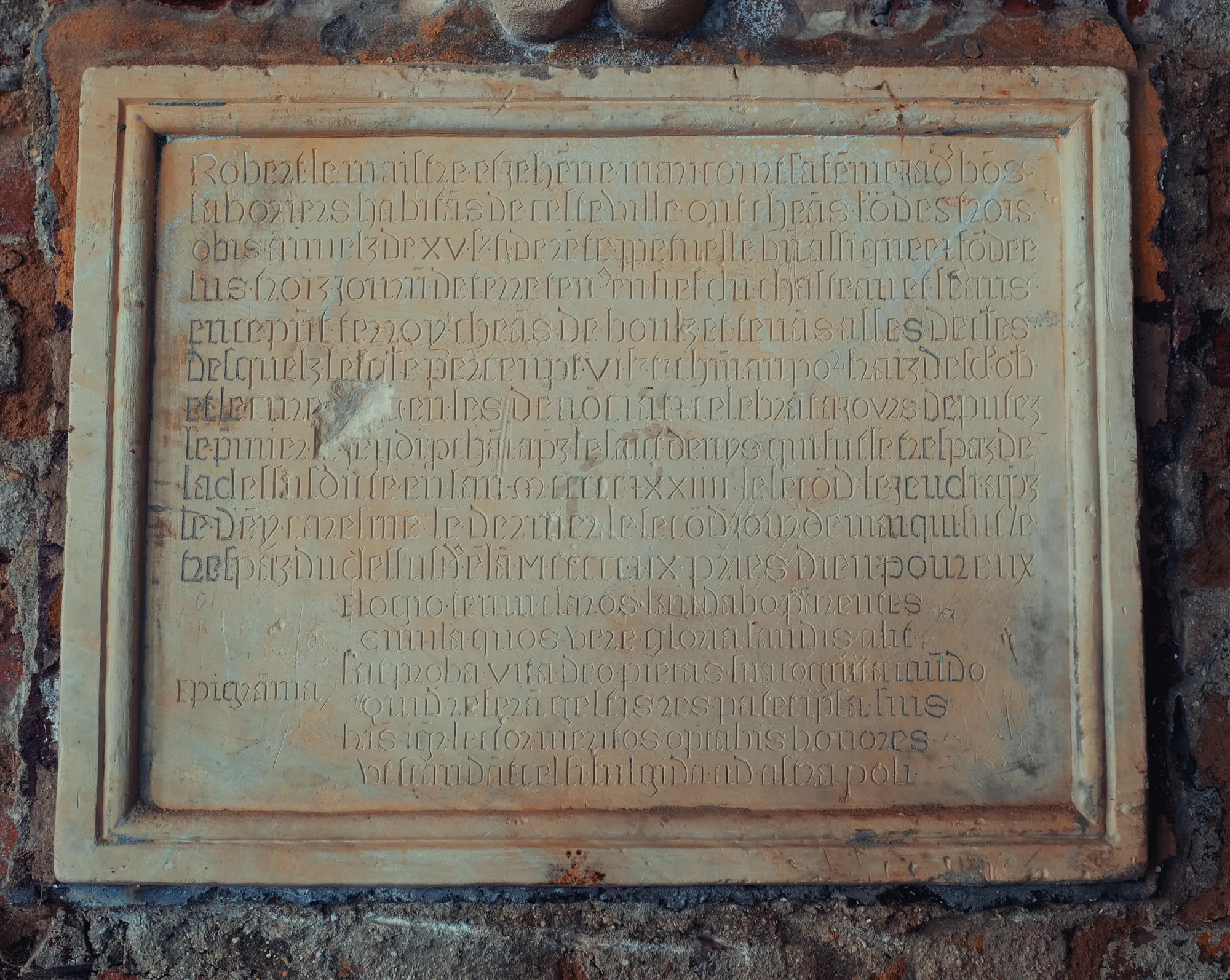
It cannot have been engraved before 1574 if Jeanne really died that year, so it is over 450 years old. With the 1524 reading, it would be over 465.
Robert Lemaistre and Jehenne (Jeanne) Maricourt, ploughmen of the village. Jeanne’s surname remains to be confirmed.
For the rest of their souls, in perpetuity: “for ever”, says the plaque.
An income secured on three journaux of land, about one hectare.
Eleven lines of 16th-century French, then six lines of Latin verse.
Robert dies on 2 May 1559, a month after the Peace of Cateau-Cambrésis and two months before King Henri II, wounded in a tournament. Jeanne dies in 1574, the year Henri III becomes king.
Reading the plaque, line by line
Tap a line to show its translation. Square brackets [ ] show what is guessed or no longer legible.
1Robert Lemaistre et Jehenne Maricourt, sa femme, jadis bons
Today : Robert Lemaistre and Jehenne Maricourt, his wife, once good
Good to know : Jehenne is the old form of Jeanne. Spelling was not fixed in the 16th century, and the small stroke above the “e” replaces an “n”.
2laboriers, habitans de ceste ville, ont chéans fondés trois
Today : ploughmen, inhabitants of this village, have founded here three
Good to know : A “laboureur” is a peasant who owns his plough and his animals, often fairly well-off. The word “ville” simply meant an inhabited place.
3obis annuelz de XV [?] de rente perpetuelle, assignée et fondée
Today : annual services (“obits”), secured by a perpetual income of 15 [unit illegible], assigned and founded
Good to know : An “obit” (from Latin obitus, death) is a mass said every year for a deceased person. “Perpetual” means with no end date.
4sur trois journaux de terre tenus en fief du chasteau et [séans ?]
Today : on three journaux of land, held in fief of the castle and [situated]
Good to know : A journal is the area a team could plough in one day: about a third of a hectare depending on the region. Three journaux therefore make roughly one hectare.
5en ce présent terroyr, [chéans ?] de boutz et tenans [assez déctes ?]
Today : on this land, with its “bouts et tenants” [the rest is uncertain]
Good to know : “Bouts et tenants” are the neighbours of a plot, at both ends and along the sides: today’s “aboutissants”.
6Desquelz […] perceupt VI [?] chacun an pour fraiz desdits ob[its]
Today : […] of which 6 [?] are taken every year for the costs of the services
Good to know : This line is damaged where the stone lost a chip. The likely meaning: part of the income pays for the costs of the masses.
7Et le curé […] iceulx […] et célébrant à toujours députez
Today : And the priest [...] these [...] and celebrating, appointed for ever
Good to know : “À toujours” (for ever) expresses the perpetuity the donors wanted.
8Le premier, jeudi prochain après le sainct Denys, qui fut le trespaz de
Today : The first, on the Thursday after Saint Denis, which was the death of
Good to know : Saint Denis falls on 9 October. According to local history, the old church was dedicated to Saint Denis (to be confirmed).
9ladessusdicte en l’an M CCCCC [L ?] XXIIII ; le second, le jeudi après
Today : the above-mentioned [Jeanne], in the year 1574; the second, on the Thursday after
Good to know : M = 1000, CCCCC = 500, L = 50, XXIIII = 24: total 1574. This is the most likely reading; without the L, we would read 1524.
10le demy caresme ; le dernier, le second jour de may, qui fut le
Today : mid-Lent; the last, on 2 May, which was the
Good to know : Mid-Lent falls on the Thursday of the third week of Lent. Here it serves as a calendar marker.
11trespaz du dessusdict, l’an M CCCCC LIX. Priés Dieu pour eux.
Today : death of the above-mentioned [Robert], in the year 1559. Pray God for them.
Good to know : End of the French text: “Pray God for them”. The six-line Latin poem follows.
The vocabulary of the plaque
The words of the plaque and their meaning today.
| On the stone | Today | Good to know |
|---|---|---|
| laboriers | ploughmen, peasants | Often a well-off peasant who owned his tools and animals. |
| habitans | inhabitants | “-ans” was written where we now write “-ants”: the “t” arrived later. |
| chéans (céans) | here, in this place | An old word, still found in literary French. |
| obit (obis) | a mass for a deceased person, said every year | From Latin obitus, death. Cousin of “obituary”. |
| rente perpétuelle | a sum paid every year, for ever | These contracts had no end date. |
| journal (journaux) | a unit of farmland area | What a team could plough in a day: about a third of a hectare. |
| tenu en fief | land depending on a lord | In return, the peasant owed dues: the land wasn’t quite his. |
| chasteau | château, castle | The “s” before the “t” vanished, replaced by the circumflex. It survives in “fête” (feste) and “forêt” (forest). |
| terroyr | terroir, the village territory | All the land around the church. |
| boutz et tenans | the neighbours of a plot | Vocabulary of legal deeds to describe the boundaries of a plot. |
| sous, livre tournois | currency of the time (struck at Tours) | 1 livre = 20 sous = 240 deniers. |
| députez | appointed | Here: appointed for a task. |
| trespaz | death | From “trépasser”: to pass beyond. |
| sainct Denys | Saint Denis (9 October) | “Sainct” with a “c”: already pronounced “saint”. |
| demy caresme | mid-Lent | Halfway between Ash Wednesday and Easter. |
| Epigramma | epigram: a short poem | From Greek epigramma, “inscription”. Originally a poem carved in stone. |
The three appointments of the year
If we wanted to follow the plaque to the letter, here is the calendar. The dates move from year to year, the rule never does. Nothing compulsory: it is a moment of remembrance, not a rulebook.
Mid-Lent falls on the Thursday of the third week of Lent, 22 days after Ash Wednesday. The appointment is therefore the following Thursday (if “demy caresme” is the right reading).
A fixed date, the easiest to remember. In 1559 the Julian calendar was still in use: Robert’s 2 May corresponds to our 12 May.
Saint Denis is on 9 October: the following Thursday therefore falls between 10 and 16 October.
The Latin poem
Six lines engraved below the French text. This is a proposed reading: the beginning of the second line is a restoration, and a Latinist may correct a few words.
| On the stone | In English |
|---|---|
| Elogio tenui claros laudabo parentes, | With a modest eulogy, I shall praise these illustrious parents, |
| Aemula quos vere gloria laudis alit. | whom a glory rivalling praise truly nourishes. |
| Laus : proba vita Deo, pietas sua cognita mundo. | Their praise: an upright life before God, a piety known to the world. |
| Quid referam ? Gestis res patet ipsa suis. | What more should I say? The matter speaks for itself through their deeds. |
| His igitur, lector, meritos optabis honores, | So, reader, you will wish them the honours they deserve, |
| Ut scandant celsi fulgida ad astra poli. | that they may climb to the shining stars of the high heaven. |
What we know, what we are looking for
We know
- A couple of ploughmen from the village founded three annual services.
- Robert died on 2 May 1559 (fairly clear reading).
- The text dates from the 16th century, in French then Latin.
- The plaque comes from the old church of Becquincourt; according to a historical note, it was found in the ruins after the First World War.
We are looking for
- The year of Jeanne’s death: 1574 (most likely) or 1524.
- The unit of the income (livres? sous?) and the detail of lines 3 to 7.
- Jeanne’s exact surname: Maricourt?
- A few words of the Latin poem.
- A photo or document from before 1914.
Do you read Latin or Old French?
Come and help: if you recognise a word, a letter or a date, write to me. The best readings will be credited on this page.
Write to me ↗Readings established from photographs, compared with the “Épigraphie” note on Hervé Bennezon’s website (2024), worth consulting for comparison. herve-bennezon.com.
Read also : History of the church · The works diary